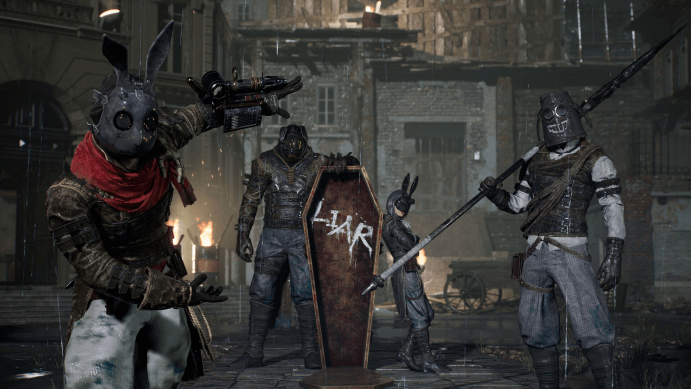
On that drizzly afternoon, when I first stepped into the streets of Crate City and watched the steampunk-style mechanical guards passing by citizens in Victorian costumes, I suddenly realized that this was no longer the soul game I was familiar with. Round8 Studio has injected a new soul into this game genre pioneered by the West with their unique oriental perspective.
I remember that I met my first strong enemy at the dilapidated underground station. The puppeteer wearing a hat bowed gracefully, and then the puppet manipulated launched an offensive like a Beijing opera martial artist. I instinctively rolled and dodged, but I retreated step by step in the continuous offensive of the other party. It was not until the third failure that I noticed that before every attack, the hat would tilt slightly — this action full of stage ritual turned out to be the key to breaking the game.
What fascinates me most is the temperament of the city. There are red lanterns hanging on the Gothic spire buildings, and the steam machinery and ink painting are interesting. Even those ferocious mechanical monsters have a little charm of oriental novels. In a forgotten theater, I found a crippled play, which recorded the singing part of Peony Pavilion in neat Chinese characters, and the mechanical actors on the stage were still tirelessly repeating the final performance.
As the adventure deepened, I gradually understood the core concept that the Korean team wanted to express. Instead of simply copying the difficulty of soul games, they cleverly weave the “reincarnation” and “cause” in oriental philosophy into the game mechanism. Every death is not a punishment, but a deeper understanding of the enemy; every BOSS is not an obstacle, but a fable that must be listened to carefully.
On that moonlit night, I still can’t forget the battle with the final puppeteer at the top of the church. When we made the last blow at the same time, his mask shattered, revealing a face similar to mine. At that moment, the artistic conception that the game wanted to convey suddenly became clear: what we fought against was never the external enemy, but the lying “Pinocchio” in our hearts.
After passing the customs, I walked alone in the rain, and the piano melody in the game still echoed in my mind. The most touching thing about this game is not how difficult it is, but that it allows every player to finally find his true self through countless failures.
If you also want to experience the unique sparks of the collision of Eastern and Western cultures, _Lies of P_ will take you into a dream world that is both familiar and strange. Here, every block is like splashing ink, and every dodge is like dancing a classical dance. This is not only a game, but also an oriental meditation about self-awareness.